Garden Landscaping08 Apr 20266 min read
Low Maintenance Garden Design Sydney: How to Get One That Actually Works
Practical low-maintenance garden design tips for Sydney homes. Plant choices, layout decisions, and design moves that cut ongoing work without making the garden look bare.
Key Takeaways
What this guide covers
- 01A low-maintenance garden is designed for low maintenance from the start. Retrofitting it later is much harder.
- 02Plant choice matters more than plant quantity. Native and Mediterranean species suited to Sydney cut watering, fertilising, and replacement work.
- 03Automatic irrigation, good mulching, and clean garden edging do more to reduce ongoing work than any other design moves.
A low-maintenance garden in Sydney isn't a no-care garden. It's a garden designed and built so it doesn't need constant attention to keep looking good. The biggest decisions happen at the design stage — plant choice, soil prep, irrigation, edging, mulch. Once a garden is planted with the wrong species in the wrong soil, no amount of clever maintenance can fix it. This guide covers the design moves, plant choices, and material decisions that consistently deliver low-maintenance gardens across Sydney homes.
Design for low maintenance from the start
Most high-maintenance Sydney gardens weren't planned that way. They became high-maintenance because:
- Plants were chosen for showroom appearance, not Sydney conditions
- Garden beds were built without proper soil prep
- Irrigation was skipped to save initial cost
- Mulch was thin or missing entirely
- Plant variety was over-ambitious — 20 species in a small bed
- Edging was an afterthought, so the lawn keeps invading the garden
- Hedges were trimmed to shapes that demand constant correction
Each of these is fixable at the design stage. Each is expensive to fix afterwards.
Plant choice matters more than plant quantity
A 30 m² garden bed with 8 species, mass-planted, is far easier to maintain — and looks better — than the same bed with 20 species in singletons.
A working low-maintenance plant palette:
- 1 anchor specimen per visual zone (Magnolia 'Little Gem', Frangipani, Crepe Myrtle)
- 2–3 mid-layer species (Westringia, Lilly Pilly, Murraya, Gardenia)
- 1 ground cover (Lomandra, Liriope, Mondo grass, Native Violet)
Mass each species. Repeat the palette across the garden. Resist the urge to add "one of each" plant you like — that's a collector's garden, not a low-maintenance one.
Match plants to Sydney conditions
The reliable low-maintenance plants for Sydney gardens:
Australian natives
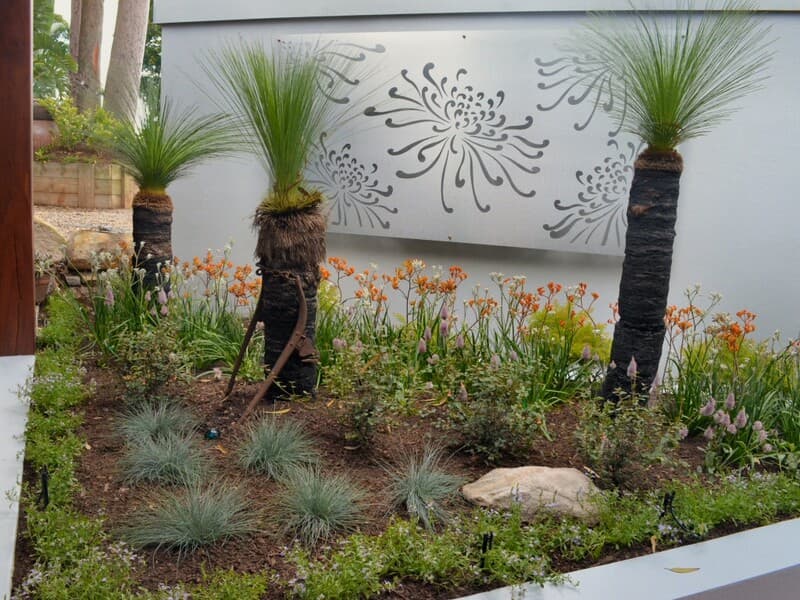
- Lomandra 'Tanika' and L. longifolia — strappy, drought-tolerant, evergreen, virtually indestructible
- Westringia 'Wynyabbie Gem' and W. fruticosa — coastal hardy, light pruning only, white or mauve flowers
- Banksia 'Birthday Candles' and dwarf Banksias — striking flowers, drought-tolerant
- Grevillea 'Robyn Gordon' and prostrate varieties — flowers most of the year, attracts birds
- Dianella caerulea and Dianella 'Cassa Blue' — strappy, blue flowers, indestructible
- Callistemon 'Little John' — dwarf bottlebrush, full sun
- Native Violet (Viola hederacea) — ground cover, semi-shade
Mediterranean species
- Olive trees — feature or hedging, drought-tolerant
- Lavender in well-drained sunny spots only
- Rosemary as low hedging or specimen
- Westringia as native rosemary
- Pittosporum 'Silver Sheen' — fast-growing, evergreen, fine-leafed screening
Reliable subtropicals
- Frangipani (Plumeria) — slow-growing, sculptural
- Strelitzia nicolai — bird of paradise, architectural
- Magnolia 'Little Gem' — evergreen, structured
Avoid in low-maintenance schemes
- Standard Camellias in too-small beds (constant pruning)
- Buddleias (need hard prune annually)
- Most annuals (replace seasonally)
- Roses (regular pruning, fertilising, pest management)
- Wisteria and aggressive vines (constant control)
- Tropical Heliconia in cold pockets
- Most Hibiscus (pest pressure)
Get the soil right
Sydney soils are not great planting soils as-is. Clay-heavy sites (inner west, Hills District, parts of Ryde) need amendment for drainage and structure. Sandy coastal sites need organic matter to retain moisture.
A proper soil prep:
- Test the existing soil — pH, texture, drainage
- Add composted organic matter at 100mm minimum across all garden beds
- Add gypsum for clay soils (1kg/m²)
- Dig planting holes twice the width of the rootball
- Backfill with amended soil, not native soil
- Mulch heavily afterwards
Soil prep costs $1,000–$3,000 on most projects. Replacing dying plants because of bad soil costs the same plus the time lost.
Install drip irrigation
Hand-watering a Sydney garden through summer is a nightly job nobody actually does. Drip irrigation, installed during construction, takes that decision out of the equation.
A well-designed drip system:
- Drip lines along garden beds (efficient, no overspray, no leaf wetting)
- Pop-up sprays only for lawn areas
- Tap timer at minimum, smart controller for best results
- Multiple zones for different plant types and exposures
- Rain sensor to skip watering after rain
Cost: $1,500–$5,000 to install on most Sydney gardens. Pays back in plant survival, water bills, and saved time within two seasons.
Mulch generously and re-mulch annually
Mulch reduces evaporation, suppresses weeds, regulates soil temperature, and slowly improves soil structure. It's the single most cost-effective low-maintenance move.
For Sydney gardens:
- Bark mulch (fine, 75mm depth) — formal, dark, suits contemporary planting
- Sugarcane mulch — fast-breakdown, good for new planting, replenish annually
- Pebbles or river stones — Mediterranean / native gardens, no replenishment needed
- Crushed sandstone — character finish, suits Federation/Victorian fronts
- Forest litter — natural-look, native gardens
Avoid: thin mulch (under 50mm), rubber mulch (looks plastic), and lawn clippings (mat together).
Define edges properly
Garden edges separate "designed garden" from "rough planting." A bed with no edge looks unfinished even when the planting is excellent. The edge also stops lawn invading the garden.
Effective edging:
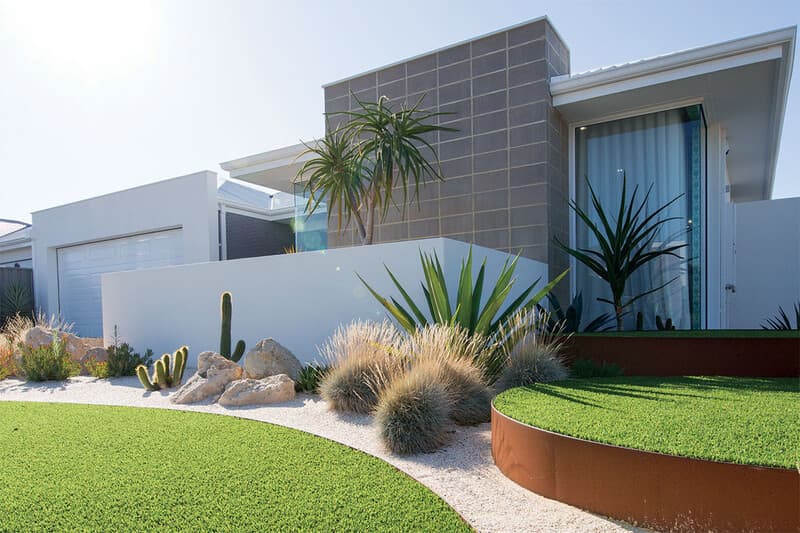
- Steel edging (corten or galvanised) — clean, minimal, lasts decades
- Sandstone or stone block — character, suits heritage homes
- Concrete kerb — formal, paintable, durable
- Brick on edge — traditional
- Hardwood timber sleepers — informal, warm
Avoid plastic garden edging. It looks cheap, fades fast, lifts at the joins.
Reduce or eliminate the lawn
A lawn that's actually used (kids, pets, sitting on the grass) is worth keeping. A lawn that exists "because gardens have lawns" is the highest-maintenance feature in most low-maintenance schemes.
The honest options:
- Replace with planted ground cover — Lomandra, Liriope, Native Violet, Mondo grass, prostrate Grevillea
- Replace with paving and planted beds — works well for narrow Sydney sites
- Replace with a gravel garden — Mediterranean style, near-zero maintenance
- Replace with synthetic turf — best for shaded courtyards, dog runs
- Keep a small lawn if it's used, with Sir Walter buffalo for low-maintenance performance
Use hard surfaces that don't demand work
The hard surfaces in a low-maintenance garden need to handle weather without staining, growing moss, or pitting:
- Concrete pavers with sealed joints — durable, easy to lift if needed
- Sandstone with sealer — beautiful, ages well
- Bluestone — dense, low-porosity, contemporary
- Porcelain pavers — virtually zero maintenance
- Exposed aggregate concrete — solid, mid-century-friendly
- Crushed gravel paths — informal, native gardens
Avoid: limestone in shade (mould), unsealed sandstone in entertaining areas (stains), polished concrete outdoors (etches).
Layout decisions that reduce maintenance
A few design moves that significantly cut ongoing work:
- Generous bed widths — narrow strip beds along boundaries are awkward to maintain. Wider beds (1.5m+) are easier to plant, mulch, and walk into.
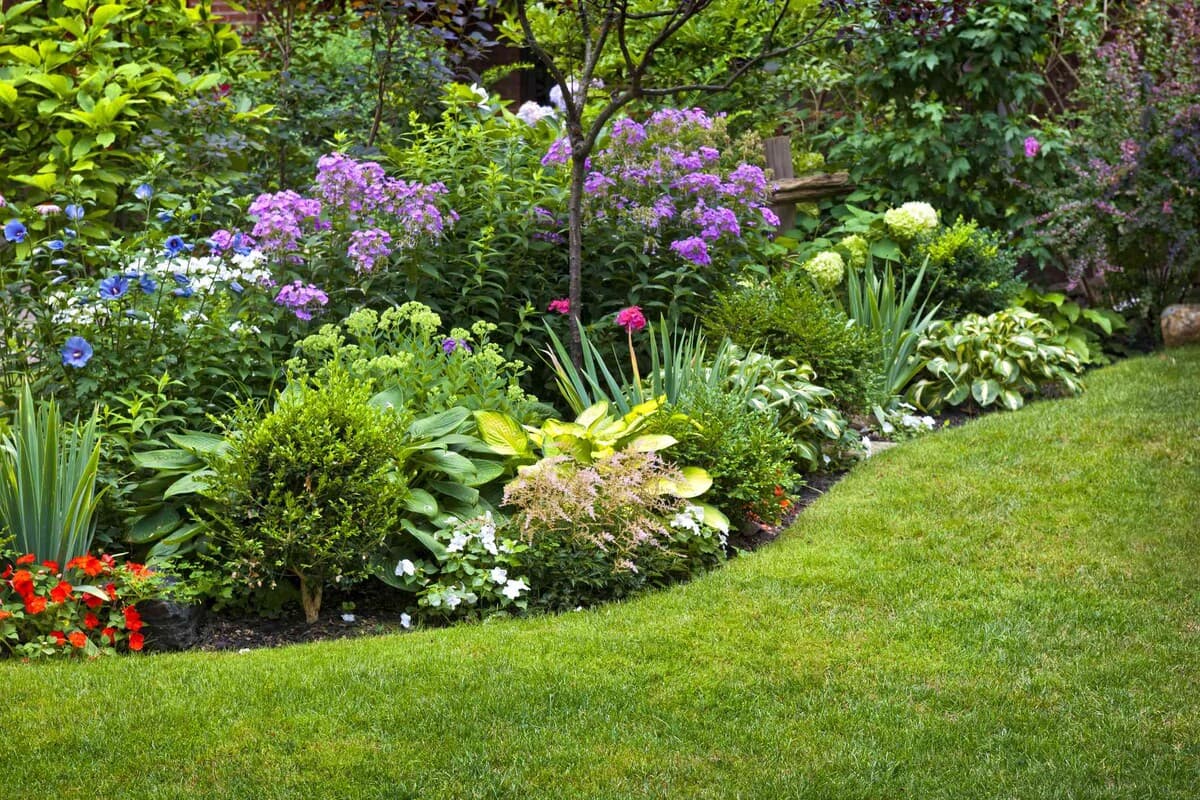
- Curved edges rather than tight corners — easier to mow alongside, easier to rake out
- Mass planting blocks — same plant in groups of 5–9 rather than singletons
- Generous mulch zones between plants — reduces weed pressure
- Smooth transitions between lawn and bed edges — no awkward corners
- Direct paths — meandering paths look pretty in photos but are awkward to maintain at the edges
Lighting that works set-and-forget
Quality outdoor lighting should be set-and-forget for at least 5–7 years.
- LED fixtures rather than halogen — last 25,000+ hours
- Hard-wired to the house circuit, not battery or solar
- Daylight sensor or smart timer so they switch themselves
- Warm white (2700K–3000K) consistent across all fixtures
- Quality fixtures — copper, brass, or 316 marine-grade stainless steel near the coast
Plan for an honest maintenance routine
Even a low-maintenance Sydney garden needs some attention:
- Quarterly tidy — light prune, weed sweep, mulch top-up
- Annual hard prune — once a year for hedges and structural shrubs
- Annual mulch top-up — restore depth where it's broken down
- Lawn mowing if any lawn — fortnightly summer, monthly winter
- Irrigation check — annually, after storms, and after any planting changes
A maintenance contractor at $80–$120 per visit, 4–6 visits a year, keeps a well-designed low-maintenance Sydney garden looking sharp for around $400–$700 per year.
Avoid the most common low-maintenance design mistakes
The patterns we see most often:
- Too many plant varieties — chaotic, hard to maintain
- Plants put in too small — saving on stock then waiting four years for impact
- No mulch — bare soil is a weed factory
- Skipping irrigation — plants stressed through summer, replaced after
- Tight corners — awkward to mow, edge, and plant
- Hedges shaped wrong — narrower at the base means lower foliage gets shaded out
Where to start
The most useful first step for a Sydney low-maintenance garden is a free site visit and conversation about how much time you genuinely want to spend on the garden. Nazscapes will walk the property, talk through which existing elements are worth keeping, and put together a planting plan and scope built around the actual maintenance commitment you want to make.

Nazscapes
Ryde-based Sydney landscaping team
Nazscapes is a Sydney landscaping company delivering design-led outdoor construction for homes that need more than surface-level garden styling. Since 2002, the team has combined planting, paving, turf, retaining, pool surrounds, and site-aware detailing into landscapes built for long-term liveability.