Front Yard Landscaping08 Apr 20266 min read
Low Maintenance Front Yard Design Sydney: What Actually Works
How to design a low-maintenance front yard for a Sydney home without losing the finished look. Plant choices, surface options, and design moves that reduce upkeep.
Key Takeaways
What this guide covers
- 01Native and Mediterranean plants suited to Sydney conditions cut watering, fertilising, and replacement work.
- 02Synthetic turf or ground cover planting eliminates mowing without making the front yard look hard or sterile.
- 03Cleaner garden edging and fewer plant varieties make a front yard look more designed, not less.
A low-maintenance front yard in Sydney isn't the same as a no-effort front yard. The goal is a frontage that looks finished and designed without needing constant work to keep it that way. The right design choices, made up front, can take front yard maintenance from a weekend job every fortnight down to an hour every couple of months. The wrong choices lock in maintenance for the next decade. This guide covers the design moves, plant choices, and material decisions that consistently deliver low-maintenance front yards across Sydney.
Why most Sydney front yards demand more maintenance than they should
Most front yards aren't high-maintenance because of one big mistake. They're high-maintenance because of a series of small ones:
- A small lawn that needs mowing every fortnight in summer but never gets used
- Plants chosen for appearance in a nursery photo, not for Sydney conditions
- Garden beds with bare soil between plants, growing weeds faster than the plants establish
- Hedges trimmed to a shape that needs constant correction
- Paving without proper edge restraints, slowly being colonised by oxalis and turf
- Irrigation either absent (so plants struggle) or set to "always on" (so plants rot)
Every one of these is fixable at the design stage. None are fixable cheaply afterwards.
Choose plants that suit Sydney conditions
Sydney has a temperate coastal climate — warm summers, mild winters, irregular rainfall, occasional hot dry spells. The plants that thrive here without constant attention are the ones suited to that climate.
Reliable low-maintenance plants for Sydney front yards:
Australian natives
- Lomandra 'Tanika' and Lomandra longifolia — strappy, drought-tolerant, evergreen, mass-plant or feature
- Westringia 'Wynyabbie Gem' and Westringia fruticosa — coastal hardy, light pruning only
- Banksia 'Birthday Candles' and dwarf Banksias — striking flowers, drought-tolerant
- Grevillea 'Robyn Gordon' and prostrate Grevilleas — flowers most of the year, attracts birds
- Dianella caerulea and Dianella 'Cassa Blue' — strappy, blue flowers, indestructible
- Callistemon 'Little John' — dwarf bottlebrush, full sun, almost zero maintenance
Mediterranean species
- Westringia varieties as native rosemary
- Olive trees for feature planting or hedging
- Lavender in well-drained sunny spots only
- Rosemary as low hedging or specimen
- Pittosporum 'Silver Sheen' — fast-growing, evergreen, fine-leaved screening
Reliable subtropicals
- Frangipani (Plumeria) — slow-growing, sculptural, drought-tolerant once established
- Strelitzia nicolai — bird of paradise, architectural, low maintenance
- Magnolia 'Little Gem' — evergreen, structured, slow-growing
Avoid in low-maintenance schemes
- Standard Camellias in too-small beds (constant pruning)
- Buddleias (constant pruning)
- Most annuals (replace seasonally)
- Roses (regular pruning, fertilising, pest management)
- Fast-growing exotic vines like Wisteria and Bougainvillea (constant control)
- Tropical Heliconia and Cordyline in cold pockets
Eliminate or downsize the lawn
A small front lawn is the highest-maintenance feature in most low-maintenance gardens. It needs mowing, edging, watering, occasional fertilising, weeding, and replacement when it fails. For a 20–30 m² front lawn that's never used, that's a lot of work for no benefit.
The honest options:
- Replace with planted ground cover — Lomandra, Liriope, Native Violet, prostrate Grevillea, or Mondo grass
- Replace with paving and planted beds — works well for narrow Sydney frontages
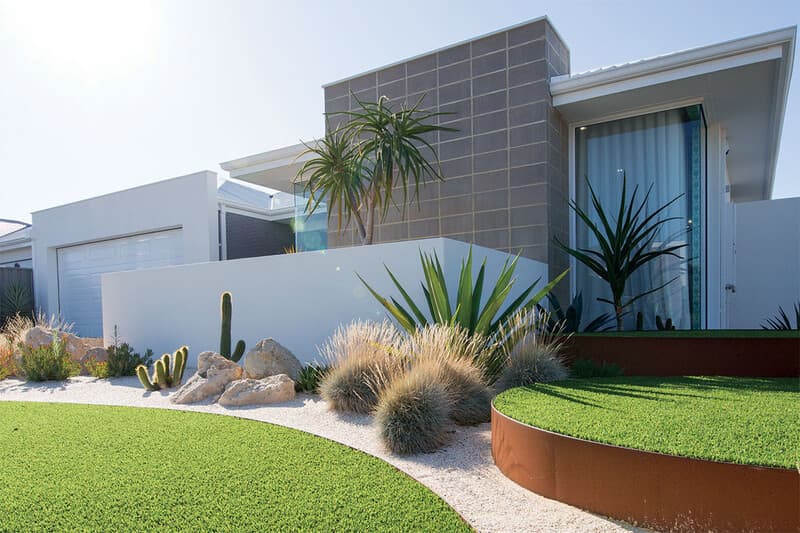
- Replace with a gravel garden — Mediterranean style, nearly zero maintenance, suits coastal homes
- Replace with synthetic turf — best for shaded courtyards where natural lawn won't establish; lasts 10–15 years
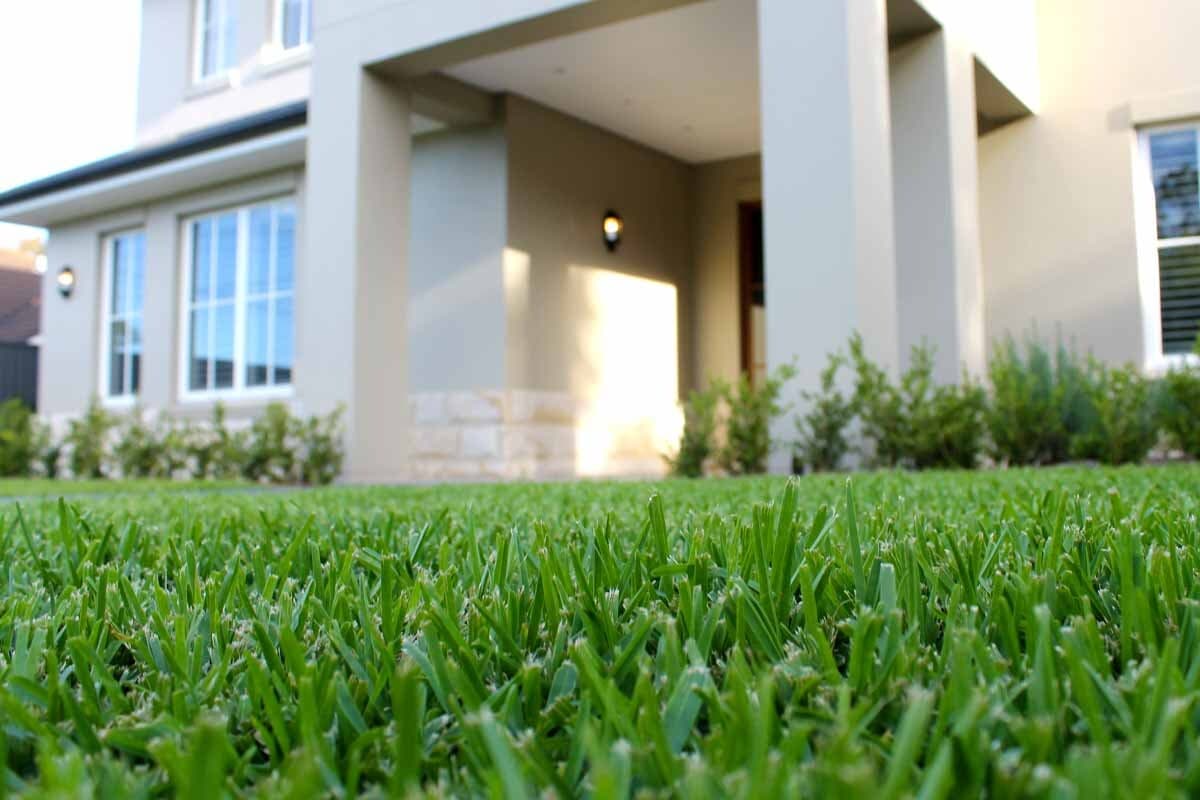
- Keep a small lawn if it's actually used (kids playing, dog area), and choose Sir Walter buffalo for low-maintenance performance
Plan irrigation properly
Hand-watering a front yard sounds romantic until the third weekend in a row when you can't be bothered. Automatic drip irrigation, installed during construction, takes that decision out of the equation.
A well-designed front yard irrigation system:
- Drip irrigation for garden beds (efficient, no overspray, no leaf wetting)
- Pop-up sprays only for lawn areas
- Tap timer at minimum, smart controller (Hunter Hydrawise, Rachio) for best results
- Separate zones for lawn, garden beds, and any pots
- Rain sensor to skip watering after rain
Irrigation costs $1,500–$5,000 to install on most Sydney front yards. It pays back in plant survival, water bills, and time within two seasons.
Use mulch generously
Mulch reduces water evaporation, suppresses weed growth, regulates soil temperature, and slowly improves soil structure. It's the single most cost-effective low-maintenance move.
For Sydney front yards:
- Bark mulch (fine, 75mm depth) — formal, dark, suits contemporary planting
- Sugarcane mulch — fast-breakdown, suits new planting, replenish annually
- Pebbles or river stones — Mediterranean / native gardens, no replenishment needed
- Crushed sandstone or recycled brick — character finish, suits Federation/Victorian frontages
Avoid: thin mulch layers (under 50mm — weeds break through), rubber mulch (looks plastic, doesn't break down), and lawn clippings (mat together and exclude oxygen).
Get the edging right
Defined garden edges are one of the strongest visual signals of a maintained front yard. A garden bed with no edge looks unfinished even when the planting is excellent.
Effective edging materials:
- Steel edging (corten or galvanised) — clean, minimal, lasts decades
- Sandstone or stone block — character, suits heritage homes
- Concrete kerb — formal, paintable, durable
- Brick on edge — traditional, suits Federation/Victorian fronts
- Hardwood timber sleepers (treated for durability) — informal, warm
Avoid plastic garden edging. It looks cheap, fades within two years, and lifts at the joins.
Reduce the number of plant varieties
A 30 m² garden bed with 15 plant species reads chaotic and is hard to maintain — every plant has different watering, pruning, and feeding needs. The same bed with 4–5 species, mass-planted, reads designed and is far easier to look after.
A workable low-maintenance plant palette is usually:
- 1 anchor specimen (Magnolia, Frangipani, Crepe Myrtle)
- 2–3 mid-layer species (Westringia, Murraya, Lilly Pilly, Gardenia)
- 1 ground cover (Lomandra, Liriope, Mondo, Native Violet)
Mass plant each species. Repeat the palette across the front yard for cohesion. Resist adding "just one more" feature plant.
Choose hard surfaces that don't demand work
The hard surfaces in a low-maintenance front yard need to handle weather without staining, growing moss, or pitting:
- Concrete pavers with sealed joints — durable, low maintenance, easy to lift if needed
- Sandstone with sealer — beautiful, ages well, sealed every 3–5 years
- Bluestone — dense, low-porosity, suits contemporary homes
- Porcelain pavers — virtually zero maintenance, no staining, suits modern aesthetic
- Exposed aggregate concrete — solid, low-cost, suits mid-century homes
Avoid limestone in shaded areas (grows mould), unsealed sandstone in entertaining zones (stains), and polished concrete outdoors (etches with rain).
Install lighting that doesn't need fiddling
Quality outdoor lighting should be set-and-forget for at least 5–7 years.
- LED fixtures rather than halogen — last 25,000+ hours
- Hard-wired to the house circuit, not battery or solar (which fail in shaded spots)
- Daylight sensor or smart timer so they switch themselves on
- Warm white (2700K–3000K) consistent across all fixtures
- Quality fixtures — copper, brass, or 316 marine-grade stainless steel near the coast
Cheap solar stake lights might save $200 upfront and need replacing every 18 months. Quality wired fixtures last a decade.
Do an honest maintenance budget
Even a low-maintenance front yard needs some attention. Budget realistically:
- Quarterly tidy — light prune, weed sweep, mulch top-up where needed
- Annual hard prune — once per year for hedges and structural shrubs
- Annual mulch top-up — restore depth where it's broken down
- Lawn mowing if any lawn remains — fortnightly in summer, monthly in winter
- Irrigation check — annually, or after any storm damage
If even this is too much, a maintenance contractor at $80–$120 per visit, 4–6 times a year, keeps a well-designed low-maintenance Sydney front yard looking sharp for around $400–$700 a year total.
Where to start
The most useful first step for a Sydney low-maintenance front yard is a free site visit and conversation about how much time you genuinely want to spend on it. Nazscapes will walk the property, talk through which existing elements are worth keeping and which are creating ongoing work, and put together a scope built around the actual maintenance commitment you want to make.

Nazscapes
Ryde-based Sydney landscaping team
Nazscapes is a Sydney landscaping company delivering design-led outdoor construction for homes that need more than surface-level garden styling. Since 2002, the team has combined planting, paving, turf, retaining, pool surrounds, and site-aware detailing into landscapes built for long-term liveability.