Paving & Pathways08 Apr 20266 min read
Driveway Paving Sydney: Materials, Costs, and What to Avoid
A practical guide to driveway paving in Sydney. Material choices, base requirements, costs, and the mistakes that lead to driveways failing within a few years.
Key Takeaways
What this guide covers
- 01Driveways need a thicker, stronger base than path or patio paving because of vehicle loads.
- 02Concrete pavers, brick pavers, and natural stone all work for driveways. Each has cost and durability trade-offs.
- 03Most driveway failures come from cutting corners on excavation, base depth, and edge restraints.
A driveway is one of the most demanding paving applications in a Sydney residential project. Vehicle weight, daily use, weather exposure, and the need for kerb appeal all have to be balanced. Get the materials and the base preparation right and a paved driveway lasts decades. Get them wrong and the driveway shifts, cracks, or fails within a few years. This guide covers the materials that suit Sydney driveways, the base preparation that determines longevity, the cost ranges for each option, and the mistakes that cause early failure.
What makes a Sydney driveway different from a path or patio
A driveway has to handle:
- Vehicle wheel loads — typically 1.5–3 tonnes per vehicle, concentrated under tyres
- Turning forces — wheels twisting on the surface as cars manoeuvre
- Daily use — every day, sometimes multiple times
- Sydney weather — UV, summer heat, intense rain, occasional hail
- Oil drips and tyre marks — surface staining
- Council kerb crossover — the connection to the street is council-controlled
These demands mean a driveway needs deeper excavation, a stronger base, more robust paver specifications, and proper edge restraints. A path-grade construction will fail under a driveway's daily loads.
Driveway paving materials
Five materials dominate Sydney driveway projects:
Concrete pavers (vehicle-rated)
Most common Sydney driveway material. Modern concrete pavers in 60mm or 80mm thicknesses are vehicle-rated and durable.
Strengths: Cost-effective ($130–$200 per square metre installed), wide range of colours and finishes, easy to lift and re-lay if a service runs underneath, won't crack from minor ground movement.
Weaknesses: Less character than natural stone, can fade over 10–15 years.
Best for: Most Sydney residential driveways, contemporary and modern homes.
Brick pavers (vehicle-rated)
Traditional brick pavers in herringbone or basket-weave patterns. The bond pattern is what gives brick driveways their strength under vehicle loads.
Strengths: Suits character homes (Federation, Victorian, Inter-war), durable, classic aesthetic.
Weaknesses: Smaller format means more joints (more grout maintenance), can be slippery when wet if too smooth, $150–$250 per square metre installed.
Best for: Heritage homes where the brick aesthetic suits the period.
Sandstone pavers
Natural Sydney sandstone in vehicle-rated thicknesses (typically 60mm or thicker, on a robust base).
Strengths: Beautiful, suits heritage architecture, ages well, distinctive Sydney look.
Weaknesses: Most expensive option ($250–$400+ per square metre installed), porous (needs sealing), heavier so requires deeper base.
Best for: Heritage homes, premium projects, character-led front yards.
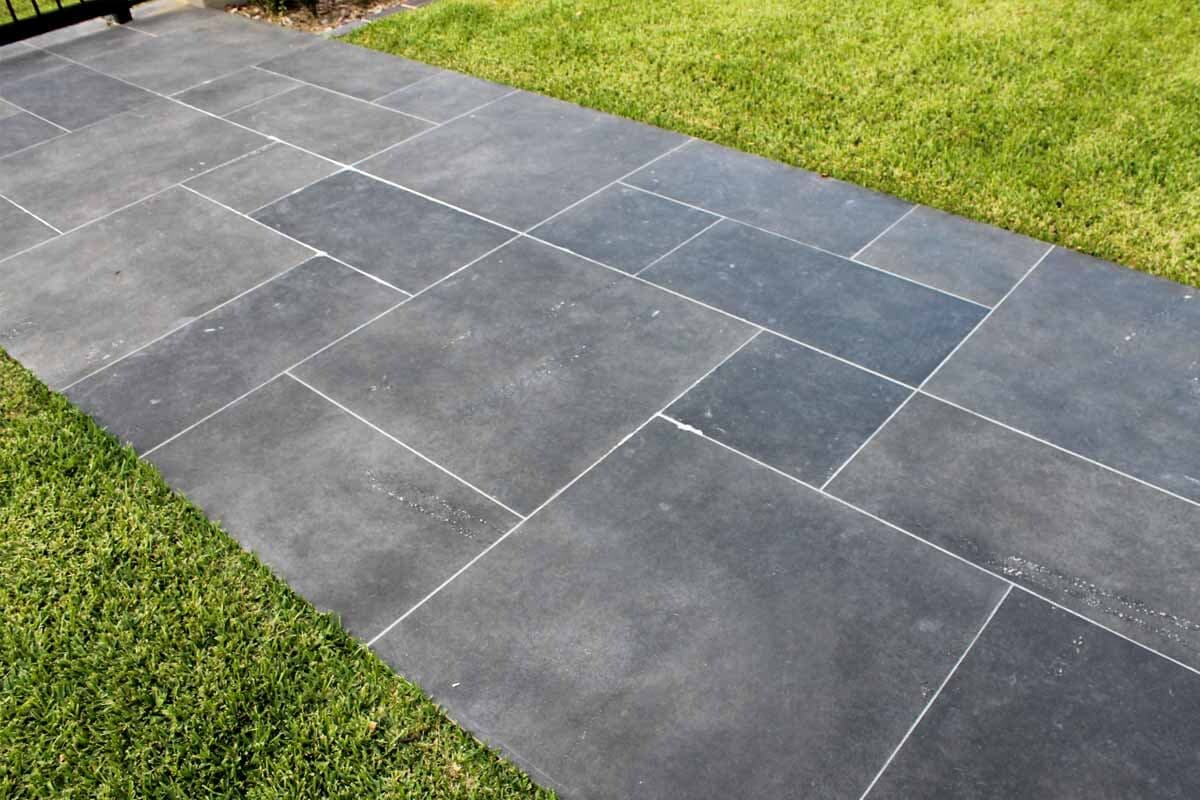
Bluestone or basalt cobblestones
European-style cobblestones in basalt or bluestone.
Strengths: Distinctive aesthetic, very durable, suits Mediterranean and contemporary architecture.
Weaknesses: Premium price ($300–$500+ per square metre installed), slower to install, can be uneven underfoot if cobble-style.
Best for: Architectural projects, premium contemporary homes, French-provincial or Mediterranean styles.
Exposed aggregate concrete
Decorative concrete with the surface aggregate exposed. Not technically a paver but commonly chosen for driveways.
Strengths: Lower cost than pavers ($100–$160 per square metre), durable, good slip resistance, monolithic finish (no joints to maintain).
Weaknesses: Cracks over time (control joints help but don't eliminate), looks utilitarian, hard to repair if a service line below ever needs work.
Best for: Budget-sensitive projects, mid-century modern aesthetics, large simple driveways.
Base preparation — what makes driveways last
The single biggest factor in driveway longevity is the base preparation. Most failed Sydney driveways aren't the paver — they're the base.
Standard driveway base specification
- Excavation to a minimum 300mm below finished surface (more for poor underlying soil)
- Geotextile fabric between the road-base and the underlying soil
- DGB20 road-base in two 100mm compacted layers, each compacted with a vibrating plate or roller
- Bedding sand at 25–30mm of clean coarse sand, screeded smooth
- Pavers laid in a chosen pattern, joints kept tight
- Polymeric joint sand swept in and watered to set
- Edge restraints poured concrete haunches along all edges
Where deeper base is needed
- Heavy clay underlying soil — common in Hills District, Parramatta, parts of Ryde — needs additional drainage and possibly geotextile
- Loose fill or made-up ground — common in newer developments — needs deeper base or sometimes a structural slab
- Steep driveways — need additional design for grade and drainage
- Trucks, 4WDs, large vehicles regularly — heavier loads need deeper base (350–400mm)
Why path-grade base fails under driveway loads
A path or patio sits on 100mm of road-base. A driveway needs at least 200mm. The difference in performance:
- A 100mm base under a path holds up fine for foot traffic and light furniture
- The same 100mm base under a driveway compresses unevenly under wheel loads
- Pavers sink into the ruts, edges drop, joints open up
- Within 18–24 months the driveway is visibly failing
This is the most common reason cheap "driveway" quotes fail — they're path-grade construction at driveway prices.
Pattern matters for strength
The way pavers are laid affects how well the driveway handles vehicle loads:
Herringbone (45° or 90°)
The strongest pattern for vehicle loading. The interlocking nature of herringbone resists shear forces (the sideways push wheels create when turning). The Sydney standard for paved driveways.
Stretcher bond (running bond)
Pavers laid in straight rows with offset joints. Adequate for driveways but not as strong as herringbone — pavers can shift in the direction of travel over time.
Stack bond
Pavers aligned in a grid. Visually clean but weakest for vehicle areas — every joint aligns, creating planes of weakness.
Basket-weave
Two pavers laid together, alternating direction. Traditional, suits heritage homes, performs well under vehicle loading.
For most Sydney driveways, herringbone is the default unless there's a specific design reason for an alternative.
Edge restraints — non-negotiable
Pavers spread sideways under vehicle loads without edge restraints. The standard edge details:
- Concrete haunches poured along all paving edges (most common)
- Stone or brick edging if the look matters
- Steel edging for contemporary aesthetic
The edge restraint should extend to the full depth of the paver and into the road-base. Skipping or undersizing edge restraints is the second most common cause of driveway failure after base prep.
Drainage — critical for paved driveways
Driveways have to shed water. Standing water deteriorates the surface and can wash out the bedding sand under the pavers.
Standard drainage:
- Surface fall of 1:80 minimum along the length of the driveway
- Crown in the centre with falls to both sides on flat sites
- Linear drains (channel drains) at the bottom of sloped driveways or where the driveway meets the garage
- Connection to legal stormwater at all collection points
Skipping drainage on a driveway leads to:
- Pavers sinking where water collects
- Joint sand washing out
- Stains and moss growth on persistently wet sections
- Water entering the garage
Council kerb crossover
Where a driveway meets the street, the kerb crossover is council-controlled:
- New crossover requires council approval and inspection
- Crossover replacement also requires approval
- Crossover dimensions are specified by council (usually 3m–6m wide)
- Construction standards are specified (typically concrete, sometimes paved)
- Cost typically $4,000–$8,000 once council fees and contractor work are included
If the driveway project includes a new or replaced crossover, factor in:
- 4–8 weeks for council approval
- Coordination with the wider driveway project
- Possible utility relocation (water meter, gas, telecoms)
- Possible street tree management (TPO considerations)
Driveway cost ranges
Real Sydney driveway pricing:
Small driveway (40–60 m²)
- Concrete pavers, standard install: $7,000–$12,000
- Sandstone pavers: $14,000–$22,000
- Exposed aggregate concrete: $5,500–$9,000
Standard driveway (60–100 m²)
- Concrete pavers: $10,000–$20,000
- Brick pavers: $12,000–$22,000
- Sandstone or premium: $20,000–$35,000+
Large driveway (100–200 m²)
- Concrete pavers: $18,000–$40,000
- Premium materials: $30,000–$70,000+
Add-ons that affect total cost
- New kerb crossover: $4,000–$8,000
- Removal of existing driveway: $50–$100/m² depending on material and access
- Drainage and pit work: $1,500–$5,000
- Lighting along the driveway: $2,000–$6,000
- Edge planting and finishing: $2,000–$8,000
What a good Sydney driveway quote should include
A clear written quote separates:
- Removal of existing driveway and disposal
- Excavation depth and method
- Geotextile and base material specification
- Paver supply (brand, size, thickness rating)
- Pattern and laying method
- Edge restraint type
- Joint sand specification
- Drainage detail
- Crossover work if included
- Council coordination if included
- Site clean-up and finished levels
Common Sydney driveway mistakes
The patterns we see most often:
- Cheap base — path-grade base under driveway loads, fails within 2 years
- No edge restraints — pavers spread sideways
- Stack bond pattern — joints align, planes of weakness fail under wheels
- No falls — water pools, surface deteriorates
- Wrong paver thickness — 40mm pavers under vehicle loads (need 60mm minimum)
- Skipping joint sand — sand washes out, joints grow weeds
- No coordination with kerb crossover — driveway built, then crossover doesn't line up
Where to start
If you're planning a Sydney driveway project, the most useful first step is a free site visit to assess the existing surface, the underlying soil, the access, and any council coordination required. Nazscapes will recommend the right material and base specification, coordinate any kerb crossover work, and put together a written quote covering the full scope so the driveway lasts decades, not seasons.

Nazscapes
Ryde-based Sydney landscaping team
Nazscapes is a Sydney landscaping company delivering design-led outdoor construction for homes that need more than surface-level garden styling. Since 2002, the team has combined planting, paving, turf, retaining, pool surrounds, and site-aware detailing into landscapes built for long-term liveability.